

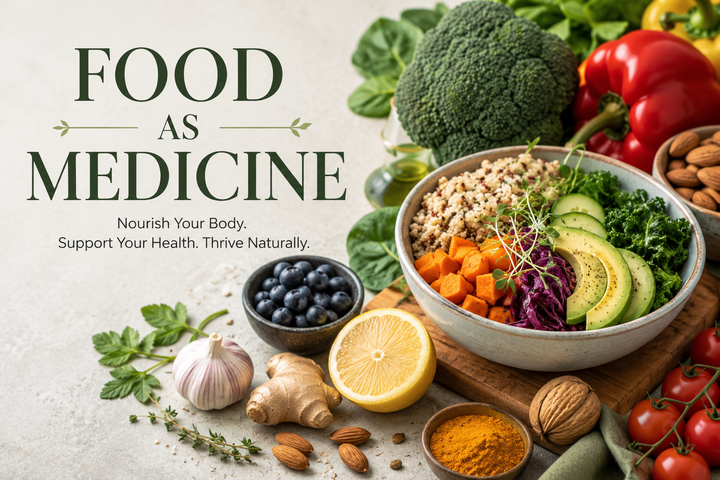
What if some of the most powerful tools for fighting diabetes and heart disease are already sitting in our kitchens?
For years, healthcare conversations have largely focused on medications, hospital visits, and treatment plans. While these remain important, a growing body of evidence is forcing us to ask a critical question: are we paying enough attention to food?
Across Nigeria and many parts of the world, diabetes and cardiovascular diseases are rising at an alarming rate. More young adults are being diagnosed with hypertension. More families are struggling with blood sugar control. Yet, many of these conditions share one common risk factor: diet.
This is where the concept of Food as Medicine comes in.
Food as Medicine is not about replacing doctors with diets or promoting unrealistic wellness trends. Rather, it recognizes that nutrition can play a significant role in preventing, managing, and even reducing the progression of chronic diseases when integrated into healthcare systems. Recent scientific evidence continues to support the idea that dietary interventions can improve cardio-metabolic outcomes, reduce healthcare costs, and enhance quality of life (Volpp et al., 2023).
The relationship between nutrition and disease is not new. However, what has changed is the strength of the evidence. Recent reviews have shown that healthy dietary patterns can significantly improve blood glucose control, body weight, blood pressure, and cardiovascular risk factors among individuals living with type 2 diabetes (Bonekamp et al., 2023).
Interestingly, researchers are no longer focusing on single nutrients alone. The conversation has shifted toward overall dietary patterns. Studies published between 2023 and 2025 suggest that Mediterranean, DASH, plant-based, and low-glycaemic dietary patterns consistently demonstrate benefits for blood sugar regulation and cardiovascular health (Whiteley et al., 2023; Gong et al., 2025).
But what does this mean in practical terms?
It means that a plate filled with vegetables, beans, fruits, whole grains, fish, nuts, and healthy oils is doing much more than satisfying hunger. These foods provide fibre, antioxidants, healthy fats, vitamins, and minerals that help reduce inflammation, improve insulin sensitivity, lower cholesterol levels, and support healthy blood vessels.
Wang et al. in 2023 further found that healthy plant-based dietary patterns were associated with lower risks of type 2 diabetes and cardiovascular disease, particularly when diets emphasized fruits, vegetables, legumes, and whole grains rather than highly processed plant foods.
At the same time, evidence continues to mount against diets heavily dominated by ultra-processed foods. A large umbrella review involving nearly 10 million participants linked higher consumption of ultra-processed foods with increased risks of cardiovascular disease, type 2 diabetes, obesity, and premature mortality.
The reality is that many Nigerian households are increasingly exposed to these foods. Convenience foods, sugar-sweetened beverages, highly processed snacks, instant meals, and excessive fast-food consumption have become more common, particularly in urban areas. Unfortunately, convenience often comes at the expense of long-term health.
Does eating healthy have to be expensive?
Not necessarily.
One of the biggest misconceptions about healthy eating is that it requires imported foods or expensive meal plans. In reality, many affordable Nigerian foods align with heart-healthy and diabetes-friendly dietary patterns.
Beans remain one of the most affordable sources of fibre and plant protein. Sweet potatoes can serve as a nutrient-dense alternative to highly refined carbohydrates. Vegetables such as ugu, ewedu, tete, waterleaf, and okra provide essential micronutrients and fibre. Groundnuts, soybeans, unripe plantain, oats, local fruits, and fish can all contribute to healthier dietary patterns without placing excessive financial strain on households.
Small lifestyle adjustments can also make a significant difference. Reducing sugary drinks, choosing water more often, increasing vegetable portions, limiting processed meats, using healthier cooking methods, and becoming more physically active can collectively improve cardio-metabolic health over time.
Perhaps one of the most encouraging developments is that healthcare institutions are beginning to recognize nutrition as a formal component of treatment. The American Heart Association’s Food Is Medicine initiative and several recent scientific reviews have highlighted the potential of integrating healthy food interventions into healthcare delivery for the prevention and management of chronic diseases.
Food alone cannot eliminate diabetes and heart disease. Genetics, healthcare access, physical activity, stress, and environmental factors all play important roles. However, ignoring nutrition means overlooking one of the most powerful and accessible preventive tools available.
The future of healthcare may not only be found in hospitals and pharmacies. It may also be found in the everyday choices we make at breakfast, lunch, and dinner.
Sometimes, medicine starts with what is on the plate.
References
Bonekamp, N.E., Barbaresko, J., Neuenschwander, M. and Schwingshackl, L. (2023) ‘Effect of dietary patterns on cardiovascular risk factors in patients with type 2 diabetes: A systematic review and network meta-analysis’, Diabetes Research and Clinical Practice, 195, 110204.
Boggild, A.K. (2024) ‘Editorial: Food As Medicine’, Frontiers in Nutrition, 11, 1490232.
García-Pérez, M., Seligman, H. and colleagues (2024) ‘Food as Medicine: FOODRx for Patients with Diabetes and Food Insecurity’, Healthcare, 5(1), pp. 1–14.
Gong, D., Zhang, Y. and colleagues (2025) ‘Dietary patterns and type 2 diabetes: A narrative review’, Nutrition Research, 136, pp. 1–15.
Mozaffarian, D., Aspry, K.E., Garfield, K., Kris-Etherton, P., Seligman, H., Velarde, G.P., Williams, K. and Yang, E. (2024) ‘Food Is Medicine strategies for nutrition security and cardiometabolic health equity: JACC State-of-the-Art Review’, Journal of the American College of Cardiology, 83(8), pp. 843–864.
Volpp, K.G., Berkowitz, S.A., Sharma, S.V., et al. (2023) ‘Food Is Medicine: A Presidential Advisory From the American Heart Association’, Circulation, 148(18), pp. e679–e698.
Wang, Y., Zhao, N., Wang, P. and colleagues (2023) ‘Associations between plant-based dietary patterns and risks of type 2 diabetes, cardiovascular disease, cancer and mortality: A systematic review and meta-analysis’, Nutrition Reviews, 82(4), pp. 460–479.
Whiteley, C., Samaan, Z. and colleagues (2023) ‘Determining dietary patterns to recommend for type 2 diabetes: A systematic review and meta-analysis’, Nutrients, 15(5), pp. 1–19.